25 March 2026
Pre-auction exhibition for the 13th Charity Contemporary Art Auction, Razem z Odwagą Foundation
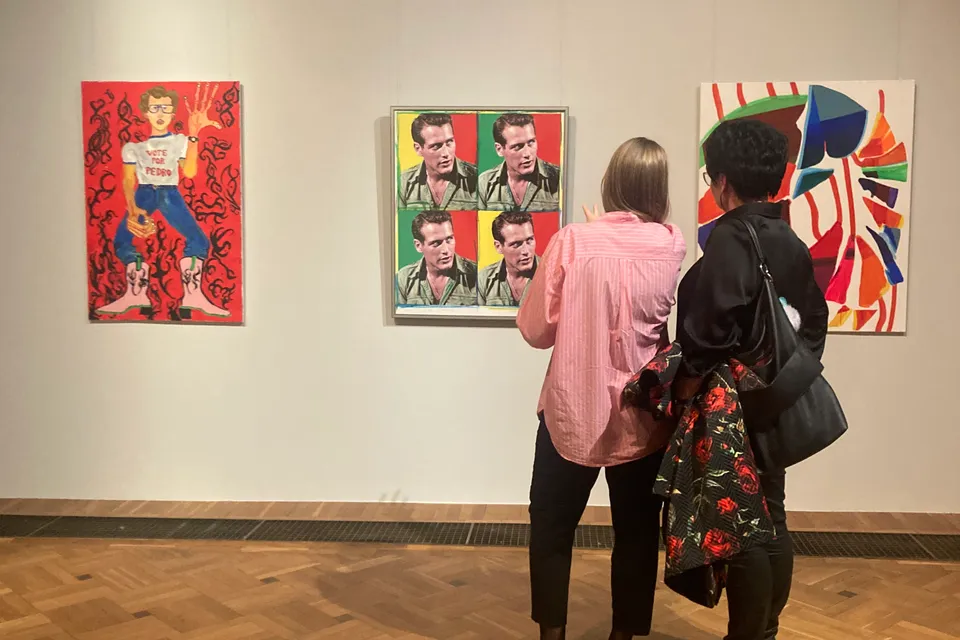
Yesterday we attended the opening of the pre-auction exhibition for the 13th Charity Contemporary Art Auction of the Razem z Odwagą Foundation, on view at Królikarnia — a branch of the National Museum in Warsaw. The auction itself takes place tomorrow at DESA Unicum, but pre-bidding is already open! Among the lots is Paweł Kowalewski's work "Paul Newman Exodus," 2026. We encourage you to take part in the auction and, in doing so, to support the Foundation and its work — it's worth helping, worth collecting❗️ Curious about the story behind the piece? Read on: The work is a pop-art-inflected tribute to Paul Newman, a man of a rich and complicated biography. Paweł Kowalewski used a still of the actor from the film "Exodus" (1960), drawing on the artist's own personal history — his father was a Jew of Polish-Hungarian descent, his mother Slovak. Although under halakha (Jewish law), which holds that national/religious belonging is inherited through the mother, Newman was not recognised as Jewish by Orthodox circles, he himself fully identified with that heritage. He often said that being a Newman meant being Jewish, which he saw as an ennobling challenge — though he was also known to say that it's harder to be Jewish than not to be. The style of the piece, drawing on Warhol's method of repeating the images of celebrities and pop-culture icons, takes on a subversive meaning here. In pop art, seriality often stripped a figure of privacy, turning them into a commercial commodity. In Kowalewski's hands, this device works the other way — it serves to analyse an identity that, beneath the blue-eyed surface of the "All-American boy," concealed a complicated heritage. The film "Exodus" is key in this context, because that role became, for Newman, a public act of affirming his own roots. Playing the character of Ari Ben Canaan, Newman — until then seen mainly as a Hollywood heartthrob — symbolically united that image with his father's Jewish heritage. The film refreshed the way Jewish protagonists were portrayed in cinema (replacing the image of the victim with that of a strong, modern leader), and for Newman himself it was a personal manifesto of an identity he chose to embrace. The colours used are no accident either — the palette built on red and green nods to the artist's own biography, a wink to those who know a certain detail of it. Kowalewski uses colours that Paul Newman himself could not have told apart — for although Newman went down in history as the owner of Hollywood's most famous blue eyes, he was, in fact, colour-blind. Choosing this work for the Foundation's charity auction closes a metaphorical biographical loop. Paul Newman was a pioneer of modern philanthropy — in 1988 he founded the first Hole in the Wall Gang Camp, giving rise to the global SeriousFun Children's Network, whose aim was to restore a carefree childhood to children battling cancer. The direct heir to that idea in our region is the Bátor Tábor centre in Hungary — the first camp of Newman's network in Central Europe, out of which grew the Polish Razem z Odwagą Foundation (formerly Bátor Tábor). Buying this work can therefore be seen as a symbolic way of joining the charitable cause Newman began.